CAC & LTV Calculator for SaaS
Your growth model is only as healthy as your unit economics. Calculate CAC, LTV, and payback in one pass — benchmarked, decision-ready, no spreadsheet lag.
Your Results
CAC and LTV for one period. The question is which channel is moving them.
Duct reads your ads, analytics and revenue tools, answers that question, and proposes the change. You approve it.
What this means
LTV:CAC tells you model health now. It doesn't tell you where the next deterioration starts.
Duct reads Google Ads, GA4 and Stripe together, so when the ratio slips it can say which channel's customers stopped staying, and propose where the budget goes instead.
How Duct works →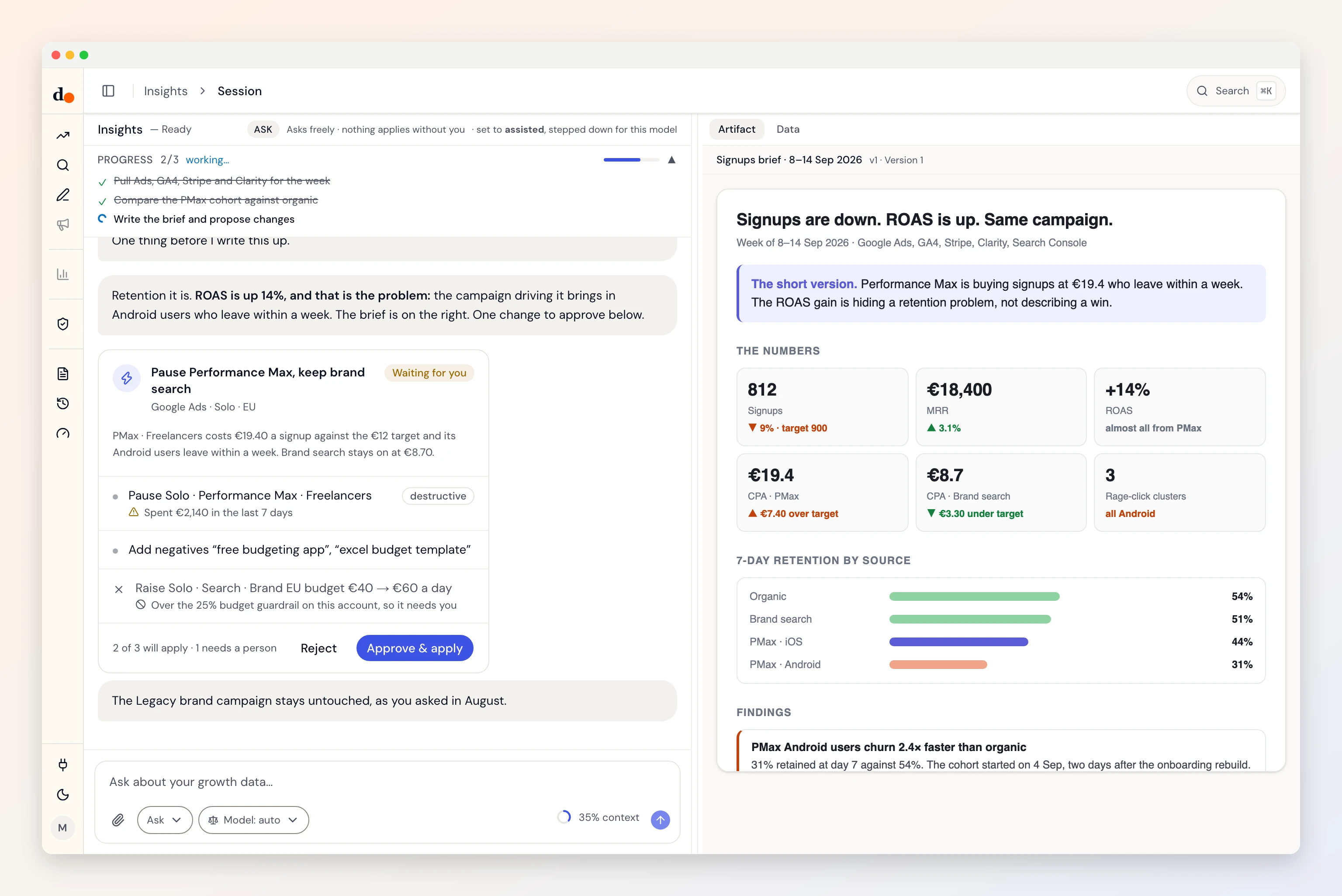
How the calculation works
This calculator uses four standard SaaS unit economics formulas:
- CAC = Total Monthly Sales & Marketing Spend ÷ Monthly New Customers
- LTV = Average Monthly Revenue per Customer × Average Customer Lifespan
- LTV:CAC ratio = LTV ÷ CAC
- CAC Payback Period = CAC ÷ Average Monthly Revenue per Customer (revenue-based). Optional gross margin % switches to contribution payback: CAC ÷ (ARPU × Gross Margin %).
Results are benchmarked against widely-cited SaaS standards: a healthy LTV:CAC above 3:1 (David Skok / OpenView), and a payback period under 12 months (OpenView SaaS Benchmarks 2024).
Why these metrics matter together
CAC in isolation tells you almost nothing. A €1,200 CAC is healthy if LTV is €6,000 (5:1 ratio) and dangerous if LTV is €1,800 (1.5:1 ratio). The pattern that matters is the relationship between these four numbers — and whether it's moving in the right direction week over week.
The most common growth PM mistake: tracking CAC and LTV monthly in a spreadsheet, noticing a problem three months late. Duct runs this calculation automatically each week and surfaces a trend alert the moment LTV:CAC starts to compress.
Limitations
- CAC calculation uses blended spend — it does not separate new business from expansion.
- LTV calculation assumes linear churn. Actual LTV may differ if churn varies by cohort.
- LTV here is revenue-based; for margin-adjusted LTV, multiply by gross margin % manually. Payback can use optional gross margin for contribution-based months to recover CAC.
- All calculations run in your browser. No data is sent or stored.
FAQ
Frequently asked questions
What is CAC in SaaS?
CAC (Customer Acquisition Cost) is the total sales and marketing spend required to acquire one new customer. Formula: CAC = Total Sales & Marketing Spend ÷ New Customers Acquired in the same period. Include salaries, tools, ad spend, and agency fees in the numerator for an accurate figure.
How do I calculate customer lifetime value (LTV)?
LTV = Average Monthly Revenue per Customer × Average Customer Lifespan in months. Alternatively: LTV = ARPU ÷ Monthly Churn Rate. For example, if ARPU is €100 and average lifespan is 36 months, LTV = €3,600. If monthly churn is 2%, LTV = €100 ÷ 0.02 = €5,000.
What is a good LTV:CAC ratio?
A good LTV:CAC ratio for SaaS is above 3:1. This means for every €1 spent acquiring a customer, you recover €3 in lifetime value. A ratio of 2–3:1 covers costs but doesn't build sustainable economics. Below 2:1 typically means the model isn't viable at scale. Above 5:1 often signals underinvestment in growth.
What is CAC payback period?
CAC payback period is how many months it takes to recover your acquisition cost from a customer's monthly revenue. Formula: Payback = CAC ÷ ARPU. A healthy payback period for SaaS is under 12 months. Above 18 months is high-risk — customers may churn before you break even.
How do I reduce CAC?
The most effective levers: build organic content that compounds (blog, SEO) to reduce paid acquisition dependence; shorten the sales cycle; improve trial-to-paid conversion to extract more value from existing top-of-funnel; and build referral or PLG loops that reduce per-customer acquisition cost over time.